

- Details
- Category: News
- Published: 24 March 2016
UN delegates met in Vienna for delegations and negotiations of an outcome document to be adopted by the general assembly in New York at the special session in 19-21 april - THE UNGASS.
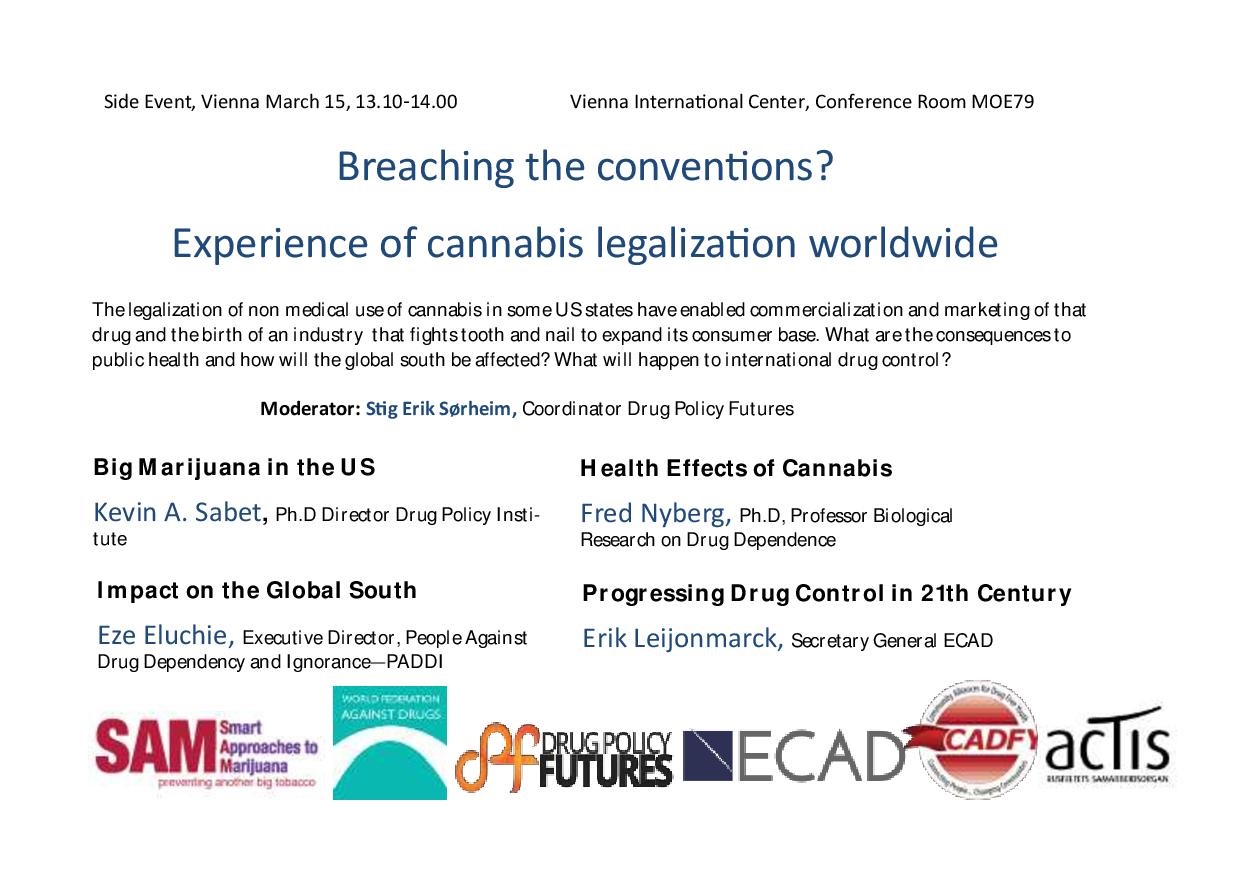
ECAD organized a side event on Cannabis legalization along with partners. The key message of the event was to highlight the birth of a new legal and commercialized cannabis industry that targets youngsters, fights regulation and promotes drug use to gain consumers in the US and beyond. The negative health effects for developing countries mirrors those from tobacco and alcohol industries aggressively seeking new markets. There is also a clear breach of international obligations since the conventions require signatories to restrict use of narcotic drugs to medical and scientific purposes only. Denying cannabis legalization is not to deny that there are no room for improvement of global drug policy however. ECAD secretary general concluded the side event with his view on how to best progress international drug control into the 21th century.
A statement was read to the CND delegates by Smart Approaches to Marijuana (SAM) President Kevin Sabet which can be read here.
The World Health Organization recently published a comprehensive report on non-medical use of cannabis which is a must read for anyone interested in the subject
The speech by ECAD Secretary General can be read down below
Ladies and Gentlemen,
It is now more important than ever to maintain and expand upon drug control. But that can be done in smart way. There are as many ways to control drugs as there are member states in the UN but what all of them (should) have in common is the recognition that use of illicit drugs should be limited to medical and scientific purposes only. The current framework of drug control allow states flexibility to adjust their responses according to local specifies.
What must be pointed out however is that we have seen the effects of commercialization and non-medical drug use before drug control both in present times, in Colorado and before. The level of opiate consumption in the 19th century is unprecedented by today’s levels. In fact for all other drugs except cannabis the prevalence is not even one per cent. The drug control system is in this regards highly successful in containing the world drug problem.
Challenges to the international community blamed on drug control can and should be addressed within the current drug control system:
- Criminal Justice Reforms in many countries have enabled alternative and smarter sanctions for criminal offenders with underlying substance abuse. Short term (harm reduction) measures to improve the health of those with substance abuse can be efficient but should not replace a strong commitment to recovery from addition.
- Prevention of initiation of drug use should be a primary goal of sound drug policy. Environmental prevention which aims to create sound and drug –free communities that prevent – don’t promote drug use.
- For countries plagued by drug traffickers and organized crime there is no shortcut. Institutions need to be strengthened, rule of law implemented, corruption addressed and development and/or alternative development facilitated.
All these actions are perfectly possible to take within the current framework of drug control. What is not in conformity with the spirit of the conventions is the simplistic call for (re)legalization of drugs, in this case Cannabis, which constitutes a regression (not progression) towards international cooperation and public health of mankind.
Let us expand upon and not discard the current regulatory system. Only thus can drug control be advanced in the 21th century.
Erik Leijonmarck, Secretary General ECAD
ECAD organized a side event on Cannabis legalization along with partners. The key message of the event was to highlight the birth of a new legal and commercialized cannabis industry that targets youngsters, fights regulation and promotes drug use to gain consumers in the US and beyond. The negative health effects for developing countries mirrors those from tobacco and alcohol industries aggressively seeking new markets. There is also a clear breach of international obligations since the conventions require signatories to restrict use of narcotic drugs to medical and scientific purposes only. Denying cannabis legalization is not to deny that there are no room for improvement of global drug policy however. ECAD secretary general concluded the side event with his view on how to best progress international drug control into the 21th century.
A statement was read to the CND delegates by Smart Approaches to Marijuana (SAM) President Kevin Sabet which can be read here.
The World Health Organization recently published a comprehensive report on non-medical use of cannabis which is a must read for anyone interested in the subject
The speech by ECAD Secretary General can be read down below
Ladies and Gentlemen,
It is now more important than ever to maintain and expand upon drug control. But that can be done in smart way. There are as many ways to control drugs as there are member states in the UN but what all of them (should) have in common is the recognition that use of illicit drugs should be limited to medical and scientific purposes only. The current framework of drug control allow states flexibility to adjust their responses according to local specifies.
What must be pointed out however is that we have seen the effects of commercialization and non-medical drug use before drug control both in present times, in Colorado and before. The level of opiate consumption in the 19th century is unprecedented by today’s levels. In fact for all other drugs except cannabis the prevalence is not even one per cent. The drug control system is in this regards highly successful in containing the world drug problem.
Challenges to the international community blamed on drug control can and should be addressed within the current drug control system:
- Criminal Justice Reforms in many countries have enabled alternative and smarter sanctions for criminal offenders with underlying substance abuse. Short term (harm reduction) measures to improve the health of those with substance abuse can be efficient but should not replace a strong commitment to recovery from addition.
- Prevention of initiation of drug use should be a primary goal of sound drug policy. Environmental prevention which aims to create sound and drug –free communities that prevent – don’t promote drug use.
- For countries plagued by drug traffickers and organized crime there is no shortcut. Institutions need to be strengthened, rule of law implemented, corruption addressed and development and/or alternative development facilitated.
All these actions are perfectly possible to take within the current framework of drug control. What is not in conformity with the spirit of the conventions is the simplistic call for (re)legalization of drugs, in this case Cannabis, which constitutes a regression (not progression) towards international cooperation and public health of mankind.
Let us expand upon and not discard the current regulatory system. Only thus can drug control be advanced in the 21th century.
Erik Leijonmarck, Secretary General ECAD